Our Success Stories
Hear from them about what we bring to institutions.




Designed for enterprises that cannot afford downtime, compliance risks, or performance instability.






Built on high-availability architecture with multi-cluster support, Assistbox ensures uninterrupted service even during peak traffic.
Enterprise-grade encryption, role-based access control, 2FA, SSO, and full compliance readiness.
Automatic reconnection logic, adaptive bitrate streaming, and resilient recording infrastructure prevent call loss or data corruption.
White-label ready, fully customizable UI, and flexible deployment options tailored to your enterprise needs.

Seamlessly integrate Assistbox with your CRM, call center, mobile apps, and enterprise systems via REST APIs, Webhooks, Web SDK, and Mobile SDK.
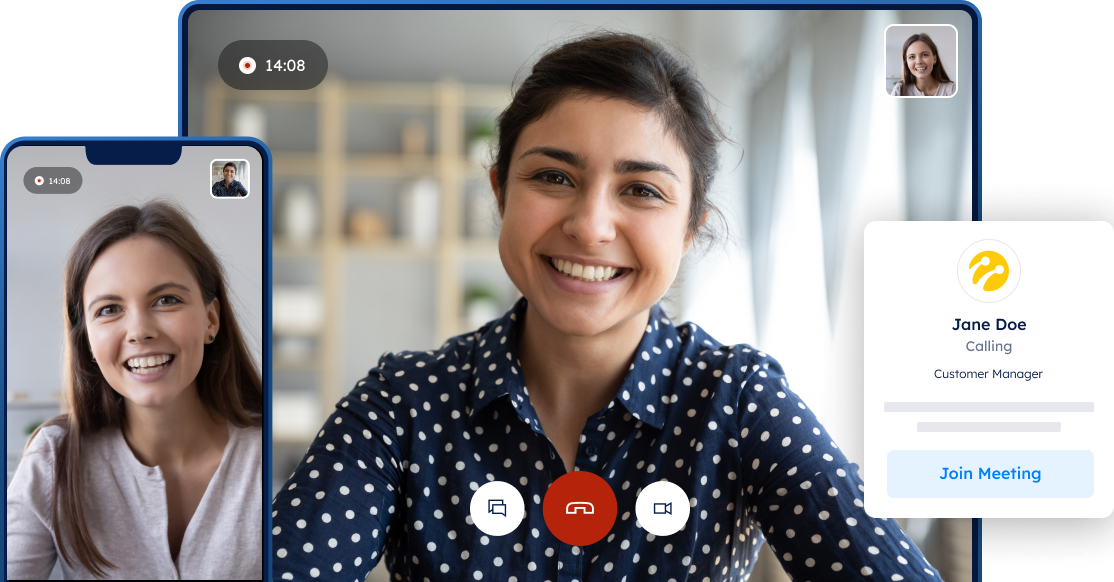
Deploy Assistbox on-premise, in dedicated deployment, or as a fully managed cloud service. Built for high availability (HA) with dedicated cluster options, multi-region scalability, and data residency controls to meet enterprise and regulatory requirements.
Designed to eliminate single points of failure and ensure uninterrupted service at scale.

Designed with failover mechanisms and redundancy across services to eliminate single points of failure.

Deploy across multiple regions with dedicated clusters to ensure regional scalability and low-latency performance.

Optimized media handling using advanced SFU-based architecture to maintain call stability, even with multiple participants.

Flexible recording models (client-side and server-side) with automatic reconnection logic to prevent session loss and data corruption.
In addition to its strong infrastructure, Assistbox offers more than a video call infrastructure with its competencies.
End-to-end encryption
TLS 1.2+ secure transport
Role-based access control (RBAC)
SSO (SAML / OAuth)
2FA support
Data residency controls
Audit logs & session traceability

Multi-region deployment
High Availability (HA) architecture
Dedicated cluster options
Horizontal auto-scaling
SLA-backed uptime (99.99%+)
No single point of failure

On-premise deployment
Dedicated deployment
Fully managed cloud
Region-based data storage
Infrastructure isolation
Custom retention policies

REST APIs
Webhooks
Web SDK
iOS / Android SDK
CRM integration capability
Call center integration
Identity provider integration

Appointment infrastructure
Queue & routing engine
Reporting & analytics
Session recording (client-side & server-side)
Multi-party sessions
Remote mobile device control

Hear from them about what we bring to institutions.
Do you provide SLA-backed uptime guarantees?
Assistbox operates on a high-availability (HA) architecture with multi-region redundancy and SLA-backed uptime guarantees.
What encryption standards do you use?
All communications are secured with TLS 1.2+ encryption. End-to-end encryption is supported depending on deployment architecture.
Can we control where our data is stored?
Yes. Assistbox supports data residency configuration and region-based storage options.
Can Assistbox be deployed on-premise?
Yes. Assistbox supports on-premise, private cloud, and fully managed cloud deployments.
Do you offer dedicated cluster options?
Yes. Dedicated cluster deployment ensures isolated infrastructure and performance guarantees for enterprise customers.
How do you ensure high availability (HA)?
Through multi-region failover architecture, clustered services, and intelligent media routing.
Can we integrate Assistbox into our existing systems?
Yes. Assistbox provides REST APIs, Webhooks, Web SDK, and Mobile SDKs for seamless integration.
Does Assistbox support SSO?
Yes. SAML and OAuth-based SSO are supported.
Can we access detailed reports and analytics?
Yes. Admin panel includes operational reporting, session logs, and performance analytics.
Do you support server-side recording?
Yes. Both client-side and server-side recording options are available.
Can Assistbox handle high concurrency?
Yes. Assistbox is built with horizontal auto-scaling and cluster-based architecture to support high-volume enterprise environments. Tested with 15.000 concurrent sessions under enterprise load conditions.
That’s why we’re ISO 27001 certified. Our architecture is enterprise-grade scalable and we ensure strong adherence to all key DPA and GDPR requirements.